Showing posts with label Stories. Show all posts

Thursday, December 19, 2019


Just wanted to sign on to say hello, post photos of a magical hike I took through Millcreek Canyon last week, and make a list of favorites of the year, which I can't help but do.


Not surprisingly, most of the writing that stuck with me this year was activism-related. This Rebecca Traister piece kept replaying in my mind all year. "Seek the organizing that is already underway," she wrote, among other illuminating advice. 

Then there was Rebecca Solnit's piece "When the Hero is the Problem" that was incredibly refreshing in its messaging. We don't need heroes, she theorized. We need community work, community efforts, community action! I also loved Naomi Klien's "How I Get it Done" interview. Her bluntness about how hard and urgently she works on environmental issues was comforting, as I feel a similar urgency / lack of balance this year. 


In terms of beautiful things that crossed my paths, I stumbled on Nikala Marie Peters' photography this year and couldn't stop scrolling through her photographs that so beautifully portray domestic life and what looks to me like a midwest childhood.

FKA Twigs "Cellophane" was the most captivating thing I heard all year. Her music video and live performance of the song left me speechless.

Alex G's House of Sugar and Angel Olsen's All Mirrors were so dreamy that I couldn't help but play them on repeat.

Jenny Odell's interview on the Longform podcast was delightful.

This Modern Love piece "Taking Marriage One Year at a Time" absolutely destroyed me in how much it spoke to me as I made the difficult / incredibly healthy decision to postpone my wedding this year. 


Of course, I woke up most days this year and read my way through books, as I do most years. 

Braiding Sweetgrass was the shining gem of everything I read and I wish it were required reading. Imagine if our schools taught a book that raised the question: "What would it be like to be raised on gratitude, to speak to the natural world as a democracy of species, to raise a pledge of interdependence?" 

Like most people, A Little Life consumed me and left me desperately sad, but mostly in a way I appreciated. The Golden State also stuck out as one of the best books I read this year. The whole novel flowed so naturally and in some magical way, seemed to leap from the page.

In terms of favorite things I watched, I can't emphasize enough how much I loved America to Me and Minding the Gap. Such important pieces of art / documentation made so close to home. Parasite and Shoplifters were also mesmerizing.

And then of course, there was Fleabag: Season Two. To me, that show was such a quiet, profound feat. I laughed a lot but I mostly sat in awe of the imperfect love that it was trying to display and so incredibly did. 


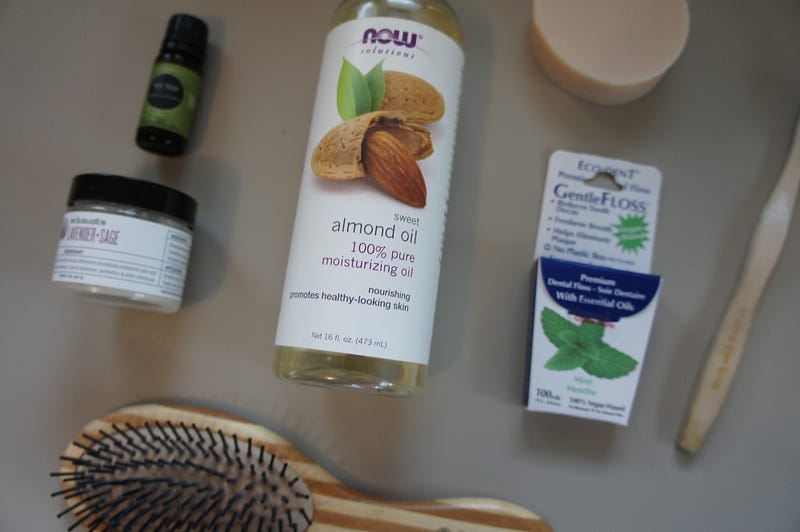
Some other things of note that made my year: finding a healthier relationship with Instagram and Twitter (haven't deleted them entirely but logged off a lot more), going to regular therapy sessions, discovering Weleda's Skin Food, fitting in a lot of twenty-minute yoga sessions at home with Adriene, getting a little bit better at learning how to live without a plan.

All I can say is, it was a year. Now on to the next decade (!).

Sunday, January 20, 2019


I'm back on here because another year has started and I love using the new year as an excuse to take stock of the art that sustained me the year prior. Things that I think deserve sharing, acknowledging, taking time with. Not everything on this list came out last year, just crossed my path in 2018, but here it goes...

Of the longer form pieces on the internet I read last year, the ones that I particularly loved include:

Courtney E. Martin's series on On Being regarding the benefits of sending your children to "underperforming" schools (the discussion continued here, here, and here).  Also loved her piece in Bright Magazine on the reality of why social change is so hard (wonderfully titled "Shooting for the Moon, Missing the Point").


Other great writing on the internet I stumbled on: Anand Giridharadas critical look at philanthropy in "Beware of Rich People Who Say They Want to Change the World" and "Democracy is not a Supermarket." Molly Fisher's piece on the #MeToo movement in "Maybe Men Will be Scared for a While."  And it doesn't sound uplifting but Mari Andrew's short essay "Optimism is Exhausting" was actually really lovely.

In terms of podcasts, I probably should have started with this but if nothing else, I wish everyone would listen to Alain de Botton's On Being interview, "The True Hard Work of Love and Relationships". I've listened to it twice and will probably give it another play soon. Also This American Life's "LaDonna" episode stopped me in my tracks.


Favorite books I read this year have to be: 

Exit West by Mohsin Hamid
Transmigration of Bodies by Yuri Herrera
Prisoner of Zion by Scott Carrier


Albums I listened to on repeat include (linking to my favorite songs in case you want to take a listen):

Saba's Care for Me
Rosalia's El Mal Querer
Marissa Nadler's Self-Titled Album


And then I probably watched too much TV this year but there was so much that was good, mainly: 

High Maintenance: Season 2
Hannah Gadsby: Nanette
The Letdown
Ugly Delicious
Salt, Fat, Acid, Heat
and of course, Queer Eye 

My heart is filled thinking back on all of this genius. 


Finally I have to mention that Alexandria Ocasio-Cortez gave me so much joy in 2018. Her outspokenness, her strength/joy in the midst of countless trolling, her refusal to give into imposter syndrome, her candidness breaking down Washington politics, her hoop earrings  it's unprecedented. I know she must not feel confident all the time but the fact that she refuses to let people take her power away inspires me every day.

So there you go, 2018 wasn't all that bad (though it was also horrifically bad). Thankfully, there were some gems that helped get me through / reminded me that change is being made.

Though of course, as I'm reminded every day as I check the news, there's always more work to do. 

Sunday, May 20, 2018

So I finished another essay recently. As is the case with most of my writing, it doesn't get at exactly everything I wanted to say but alas, here it is. (It's also on my Medium page, which you can see here. I half-heartedly pitched it to a few places but heard nothing so to the Medium page it goes!). I've been following the zero waste trend for a few years and finally got around to organizing some of my thoughts about it below. I hope you enjoy ‒ especially all of my zero waste friends, who may find it critical but hopefully it comes out as more thoughtful? Here's to hoping, and to calling this one done. As always, comments and thoughts encouraged!


The Allure of Zero Waste

It seems reasonable to say that we have a problem with plastic.

I’m often shocked at the amount of packaging — plastic or not — that I use every day, and the effect of this is often anxiety-inducing. All of the waste amassing in our oceans and landfills and alongside our sidewalks deeply disturbs me, mainly because I like things to be neat and clean but also because I know that there is little hope of it going away anytime soon. Still, the 4 million tons of trash we produce a day is a problem that I never knew what to do about until I stumbled on the term “zero waste,” a new lifestyle trend that advocates for living without consuming any single-use plastics or trash at all.

I first learned about the idea over ten years ago when Colin Beavan, a New Yorker, attempted to live the most sustainably a human possibly can. With his blog “No Impact Man,” Beavon lived a carbon-free lifestyle for a year, forgoing electricity, gas-powered transportation and packaged food to see if it were possible to live without any environmental impact. Beavon’s project stuck with me, though I never went through with it myself, and years later, I was reminded of it again as the zero waste movement began cropping up on the internet with more and more fervor.

Like Beavon’s “No Impact Man” project, zero wasters attempt to do what, to many, seems unachievable: they live without producing any trash. Rather than take a 13 gallon trash bag out to the curb every week (as I do), zero wasters collect their trash in a small mason jar, filling it up over the year, if that. Subscribing to a zero waste lifestyle intrigued me from the beginning. The purity, sanctimony, perfection of it all drew me in, especially since I try to live an environmentally responsible life and often, overwhelmingly fail.


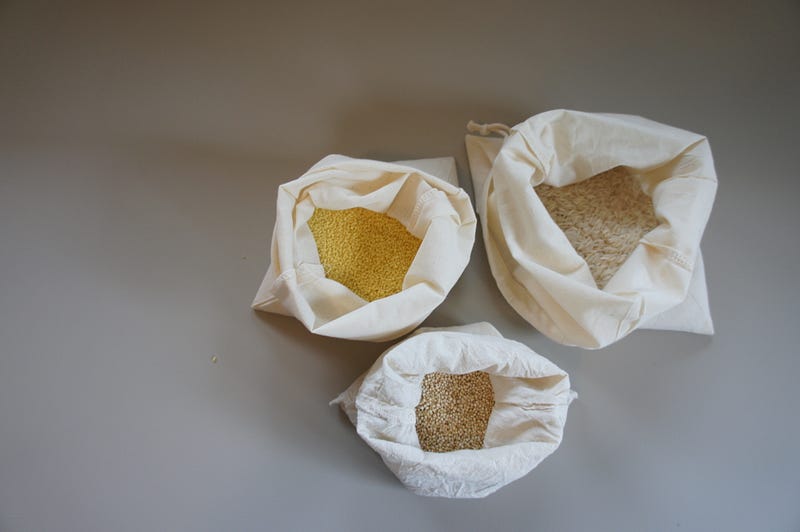
After reading through zero waste blogs incessantly, I began taking on some easy zero waste swaps myself: cotton cloths instead of paper towels, reusable bags at the grocery instead of plastic ones, bulk tea instead of the packaged variety. I kept telling myself that I’d go full zero waste for a month but then each week crept in, never the right time for the experiment.

Initially I thought that I would start on a Sunday at my neighborhood’s farmers market but I often woke up hungover and in need of a Gatorade, or I had brunch plans with a friend on the one day the market was open and couldn’t make it to buy local fruits, veggies and cheese unpackaged before it closed. Reality set in that going zero waste was really hard, and so I kept putting it off.

The most daunting aspect of zero waste for me was figuring out what to do about groceries. In order to avoid anything wrapped in plastic, zero waste calls for buying unpackaged fruits and vegetables, and then grains, pasta, legumes and snacks from bulk bins (using your own reusable bag for filling of course). This means making all of your food from scratch, which, for a mediocre cook like myself, sounds almost impossible.

While there’s a rhythm one develops when they do more of their own cooking, it’s hard for me to fathom how I can make three meals a day from unpackaged ingredients while also working, maintaining friendships, seeing family, exercising, going on a weekend trip, taking up a hobby or dealing with an illness. I know it can be done. The internet assures me it can be done. But while I subscribe to the tenets and the idea of zero waste, I just can’t see how one makes food without plastic wrap working its way in.

Take for example, a veggie burger and chips for dinner. The zero waste way of making a veggie burger and chips means setting aside a few hours one night to make the burgers from beans, onions, peppers, spices and an egg, and then frying one’s own potato chips. Perhaps this is doable but then what happens when I want to add ketchup and mustard? Do I grab my mustard seeds and start grinding? Also, do I have to start the whole process the day before, soaking my own beans and cooking them on the stove in order to avoid an aluminum can? Would every meal be a two day affair?

This is not impossible. Many people around the world make their meals from scratch but they are usually a) women in rural areas with no other choice or b) full time homemakers with someone else’s salary supporting them. As writer Taffy Broddeser-Akner’s mother says to her in a Bon Appetit essay, “You can either cook or work.” I work, which means I buy my grapefruit juice and almond milk in plastic and cardboard containers thank you very much.

In a way though, I am spoiled, as we all are. So much of what we buy comes in some form of packaging, and the zero waste movement is undeniably a response to this modern fact of life. I don’t go a day without consuming something (if I include the most vital act of feeding myself) and what comes along with consumption is its nasty byproduct: single use packaging. So the question is: how then do I stay sane and live my life, avoiding a pesky product I see everywhere I look?


Most zero wasters would say that the end goal of zero waste is not necessarily to arrive at a place where you produce no trash but rather, to rethink habits and reduce where you can. As Celia Ristow of the blog Litterless says, “Zero waste means progress, not perfection.” That is a sentiment I can get behind. I can rethink what I buy. I can forgo plastic in some areas. And yet, the world doesn’t really know what to do with the moderate so there tends to be a novelty in the end goal of zero.

This is bad for me, considering that I have the opposite of an addictive personality. I’m much too indifferent to go to extremes, too curious to not want to try everything. And so, while I have taken on some easy zero waste swaps, I mostly scroll through zero waste feeds on Instagram and wonder how anyone gets to that end goal. Do they have hobbies? Do they ever crave a frozen pizza? In my more cynical moments, I find myself rolling my eyes, believing it a scam (no secondhand garment has ever fit me that good, I think, staring at the young woman in her “thrift store” jeans). But of course, I am not actually opposed to the trend, just wish that social media acknowledged its difficulties within the context of real life.

Part of my objection to zero waste is laziness, sure, but also part of it is gendered. The work of making one’s life zero waste means more time spent in the kitchen, doing women’s work and part of me fears that while women slave away to curb our reliance on plastic and put as little dent in our landfill as possible, men won’t offer to help us in this fight. In addition, there’s the possibility that while women stay at home in the kitchen, men will spend their time working, rising to positions of power, perhaps making decisions of graver environmental consequence.

Of zero waste bloggers, the majority are young millennial women or stay at home mothers, a trend which makes me uneasy. I went to a zero waste meet up once and walked in to find a table full of women. A table that soon began lamenting over how to get their boyfriends or husbands on board with these new, more tedious habits. Most women are still fighting for society to see household chores as a task of both male and female head of households, and so what will happen when we add to this task list?

And what’s more, there may be deep-rooted patriarchal notions at work behind the female buy-in of this trend. Underneath it all, I wonder if there is an uneasiness in women to take up space (either in a room or via trash in a landfill) or a tendency to sacrifice so others don’t have to. I wonder if women feel they have more power in their homes than their workplace or senator’s office. Of course, perhaps it is none of these things. Perhaps it’s just an effect of its styling; marketed toward women, it leaves men hesitant to pick it up.

Regardless, I do feel there would be some resentment if I spent my nights prepping to make zero waste lunches and dinners and condiments and cleaning products while my boyfriend buys his Chipotle and goes off to rock climb every other day, as he does. While I’m busy being zero waste, will he be busy training? What then if I want to climb alongside him too?


The nuances of modern day feminism can be confusing, and ultimately a woman’s choice of how she wants to work toward change is her own. Colin Beavon, aka “No Impact Man,” ran into similar issues that many homemakers face in his “No Impact Man” documentary, saying to his wife at one point, “You only eat local food but who provides it, who cooks it, who gets up in the morning and makes you breakfast every day, does your lunch, does your dinner then generally washes the dishes when it’s all done?” Ultimately both his concerns and his wife’s as a working mother are valid. It brings up the most important theme that zero waste brings to bear, one I think that confounds us all: what are we willing to do, what are we willing to sacrifice so that we can preserve our planet?

The work of change is hard, as zero waste reminds us. Working toward social good involves difficult things like running for office, organizing over the long term, putting our kids in public schools, adopting or fostering, using our time to help a friend or a family member or stranger overcome addiction, depression, what have you. And when it comes to the environment, I think if we’re honest with ourselves, it involves similar sacrifice. It means reducing our trash, living in smaller spaces, taking public transportation, living closer to the things we need, consuming less, flying less, eating less meat.

That being said, I am far from perfect. I fly 3–4 times a year, a number I morally can’t feel right about even if I buy carbon offsets at the end of the year. And jealousy pervades me often. Daily I see clothes I would like to have; I see friends and strangers traveling places I would like to go; I think about living someplace with a yard. Still, I know that I could be doing more. I can’t help but think of my Grandpa, who grew up during the depression and still wears slippers from thirty years ago, the hole in the big toe patched up and worn away a thousand times over. Living in a world where temperatures rise and natural disasters intensify, I question what I really ask of myself (honestly, not much).

It is perhaps one of the most unpopular of opinions, that change will come with a cost to ourselves but it is one I wish we would all start to embrace. As of right now, I am not zero waste but I am making zero waste changes, trying to lessen my environmental impact. I’ve begun to feel the pang of sacrifice — either through the time that I spend preparing my own food or the money I donate or the bus trip I take instead of getting into my car — as a token, an acknowledgement that I’m doing the hard work. And when it hurts, I reach out to others doing the same to find some joy in it all.

Of course, change won’t come from just changing my own habits, as many critics of zero waste will say (an argument that honestly, I find quite banal). If I wait for everyone to become magically selfless and anti-consumerist, the results will be disastrous, but I do think there is hope that when a select group starts adopting new habits, pressure will accumulate for larger, systematic changes. Perhaps one day, plastic will be cast aside and a new, compostable version will come to fruition. Perhaps, a carbon tax will finally take effect. Until then, all I have is the power to reduce my consumption and maximize my political power.

Still, I wrestle with the hypotheticals often; my critiques of and compassion for zero waste. There are certain scenarios I wonder about, like whether it would be better to stay at home and prepare a zero waste, local, vegetarian dinner or just grab whatever I can (in whatever packaging it comes in) because I have to run to my senator’s office after work and protest whatever needs protesting. In this case, the latter may be a worthy exception.

In the end, with gender and privilege and ability wrapped up in all of this, the practicality and effectiveness of a zero waste lifestyle can be difficult to decipher but I think working toward a sustainable future will always be a hard battle, full of a thousand nuances. It’s confusing — but I suppose working toward any worthwhile goal always will be.

Friday, January 12, 2018

Okay, one last reading list because I can't help myself...

I enjoyed all of the books I read last year but I think I'm at the point where no matter what, I find most of the writing I pick up if not good, at least interesting. It's like blogger Kara Norman wrote in her recent post:
"The point of making things - songs or books or cookies or blog posts, I would say - is not necessarily to arrive at an aesthetically-pristine product, but for the artist to go through the process of making it and the audience to go through the process of receiving it. It's perhaps why, at this point in my life, I'm not sorry when I read a bad book by a favorite author. It's exciting to watch someone I respect keep trying, whether they sometimes miss the bar or not."
Only once I started creating (actually creating) did I stop looking for, as Kara says, an aesthetically-pristine product. Still of the books I read, there were some that stood out and so here they are, in no particular order:

* The Interior Circuit: a Mexican City Chronicle by Francisco Goldman: Like I said in a previous post, this was my favorite book of the year. It had a perfect mix of the personal, the political and some travel writing as well. Goldman's ode to his favorite city and his complicated love for it knocked it out of the park for me.

* Maud Martha by Gwendolyn Brooks: Brooks chronicles her narrator's every day, the small tragedies, the beauty in the somewhat mundane and all of the little moments that equate to a life. It's a classic and deservedly so.
Working Hard, Drinking Hard by Adrienne Pine: An anthropological study on Honduras, this might not be everyone's cup of tea but it was incredibly eye-opening for me and also, somewhat applicable to life in the states. It mainly looked at the violence in Honduras and those who are seen as perpetrating the violence and how they are victims themselves of even greater violence by the state. So, you know, a fun read.

* Unaccustomed Earth by Jhumpa Lahiri: Not a word missplaced or a story line that falls flat. I'm mesmerized every time I return to her work.

* Homing Instincts by Sarah Menkedick: I've been following Menkedick's journalism for a while but in her first book, she shifts gears a little, writing about motherhood while she adjusts to life stateside in Ohio. There were some really poignant moments in this book that have lingered on after reading. 

* Homegoing by Yaa Gyasi: What a masterpiece of a book. It's meticulously researched and such a creative feat, telling the story of seven generations, starting in Ghana and weaving it's way through most of American history. I can't recommend it enough.

* Rubyfruit Jungle by Rita Mae Brown: A bit dated but I think that's why I liked it. The novel also serves as a slice of history, telling the story of a woman navigating life as a lesbian in the eighties.

* Scratch: Writers, Money and the Art of Making a Living by Manjula Martin: This one was right up my alley, as a group of writers discussed how they came to make a semblance of a living off their writing. Each essay describes a different journey, which served as a nice reminder that there is no one way, it seems.

* Woman Hollering Creek by Sandra Cisneros: Like Lahiri, I love everything by Cisneros. The title story was phenomenal (I read it twice because I was so in love).

So alas, there are my reads for 2017. What about you? Any recommendations for 2018?

Sunday, December 31, 2017


2017 in a nutshell: I learned how to just get through when it came to work; I woke up before the sun came up and read, surpassing my goal of reading 24 books in one year (!); I wrote very rough drafts of three chapters of my novel; put away some money (though not as much as I would have liked); went to therapy for the first time; traveled, protested, called my senators, donated time, donated money; and planned for a cross country move, making compromises/decisions along the way.

But enough about me, what I really want to share is the writing that I stumbled upon online this year which fed me. If you have the time, I recommend making yourself some ginger tea and reading through word for word. For whatever reason, these essays and articles (and one podcast and one piece of fiction) took hold of me and have been stored away in the back of my mind ever since. Hope you enjoy.

Home is a cup of tea  /  The gap between memory, desire and (ugh) reality  /   The work you do, the person you are  /  How homeownership became the engine of American inequality  /  The ungrateful refugee  /  Let's talk about babies  /  Failing at important things  /  Under the apple tree


Lastly, I can't end this post without mentioning SZA's Ctrl, which I listened to more times than I can count (also fell in love with Juana Molina's Halo, which is great if you ever need background music while working). Played at full volume, it can make you forget about this world we live in; a wonderful escape, if only for a moment.

And with that, onto another year, which means more writing and more art that gets us through and more working to make things better and hopefully in many ways, more of the same. Hoping you're well!

Saturday, December 16, 2017


It's been a while since I've written here. In the past months, I put on an event for work to a rough degree of success, I struggled some days for many reasons (personal, professional, political), and I put down the pen for a little bit only to get really excited about coming back here.

Things are looking on the up and up these days, which makes me feel ridiculous that I felt like such a mess just a few months ago, but hey emotions, they are what they are.


In other news, did you know that Las Vegas is incredibly beautiful? I didn't, until I went there this past weekend to chase the sun and go on a climbing trip with my boyfriend for his December birthday. I don't want to speak too soon but after climbing with my boyfriend for the past year and a half, often times begrudgingly, I think I have finally caught the climbing bug. Those rocks above did it; and also maybe the realization that I can do things that I think I can't.


While my writing practice has waned these past few months, I have kept up reading as much as ever, and devoured Francisco Goldman's "The Interior Circuit: A Mexico City Chronicle" a few weeks back, deciding that it was my favorite book of the year. The book blends travelogue, memoir, and the political into one, which I think is a wonderful, perfect mix. The way he describes the country-wide grief in Mexico and how it simultaneously informs his own personal grief after tragically losing his wife is stunning.

A few years ago, I read Goldman's novel "Say Her Name," which chronicled losing his wife due to a swimming accident off the Pacific coast, and while it was beautiful, it was almost too heartbreaking to ever want to read it again. But as Goldman continues on processing his grief, his latest writing is a bit easier to digest (although the subject matter in "The Interior Circuit" is often just as dark). Some particularly gorgeous passages:

"Concentration and hours to write come more easily to me in the DF than anywhere else, especially when it rains. Time in Mexico City, at least to me, seems somehow slowed down, so that days feel twice as long as they do in New York. A mysterious energy seems to silently thrum from the ground, from restless volcanic earth, but it is also produced, I like to think by the pavement-pounding footsteps of the millions upon millions who labor every day in the city, by their collective breathing and all that mental scheming, life here for most being a steadfastly confronted and often brutal daily challenge, mined with potential treachery, but also in the best cases, opportunity, one sometimes hiding inside the other as in a shell game; also by love, desire, and not so secret sexual secretiveness, the air seems to silently jangle with all that, it's like you breathe it in and feel suddenly enamored or just horny; so much energy that in the late afternoon, I don't even need coffee."

"Though I will never be able to comprehend Aura's death, I do think I live with it now with less resistance, less corrosively, with less inner panic than before. Aura has her place inside me now, I told Nelly, though I hate that phrase and its false impression of gardened cemetery, neatness. What is Aura's place? Death and memory, never neat or orderly, always a forest and an ocean."

I mean, how perfect are those words?


In a few months, I will be off to Mexico myself for a month-long writing residency. I've been planning a trip to Mexico for a while now and am that glad it's working out, though there are many anxieties surrounding it (money for one, and also the fact that I'll be alone every day with my thoughts and a blank page. Fun!). Still, I'm excited for change and a new year and a few posts heading your way with more of my favorite writing of 2017.

Glad to be back.

Friday, May 26, 2017


A few years ago, I volunteered as a child advocate for an unaccompanied minor, which means that for a year, I worked with a 16-year-old girl from Honduras as she waited for the chance of asylum. Once a week, I would drive an hour to a Southside detention facility and play foosball with her as we got to know each other. Slowly, I began to learn her story, looking for ways to make sure her voice was heard amidst all of the bureaucracy she was enveloped in.

Most days, I walked into the facility, not knowing what type of mood she'd be in, which was understandable, as weeks turned into months and soon the trauma of spending eight months in a detention center melded with all of the trauma she had prior. She was able to leave eventually, though her story doesn't have a nice and neat ending. She had no family in Chicago so once she was transferred out, she was on her way to meet with distant relatives and for her parting gift, I put a translated copy of Sandra Cisneros' A House on Mango Street in between a few copies of People en Español, hoping that Sandra could help guide her even if I was nervous to see her go. 

It's been years, and I often wonder where she is now. I wonder if she had to go back to Honduras or if she found safety, though I know there were complications on both sides of the border.


After that year, I decided not to continue on as an advocate, mostly because I assumed that I wouldn't be in Chicago much longer (ha) but also because I came to realize that my skill set is not that of a social worker or a teacher, as much as I try. I'm much better working behind a computer, helping organizations communicate to the public, making them relevant, marketing them so they look nice and neat.

But once Trump was elected, I searched for a place to join, to put myself to work, and soon found myself at Sierra Club meetings every month. There are occasional meetings when I get frustrated, as we chug through slow, unproductive conversations about what issues we should tackle next. But I suppose that's what happens when you get people together who have never met before, with more excitement than they know what to do with but little enthusiasm for slow progress.

It's one thing to wax poetic about the changes you would like to see but it is another thing to head to a Sierra Club meeting with well-intentioned people that may or may not make much progress an hour later. It is another thing to try and help a girl as she makes her way through our legal system. It is another thing entirely to do collective work.


Of course it's not all frustrating, but it's no Instagrammable success story either. Because of the nature of group work, I have a propensity, like many, to find comfort in transforming my home into a place that reflects what I'd like to see in this world. I create a small little oasis in my one-bedroom apartment with thrifted goods and green cleaning products and reusables in a city where public transport is accessible. It is wonderful to have this control but it is also the easiest, most satisfactory step. There is a frustration -- but also a hope -- that comes with doing more.

It's hard for the cynic in me to say this but hopefully by the time I'm old, I will have seen something bigger, structures overturn, sitting in a home powered by the sun, thanking the 26-year-old me. Until then, I'll be making my way past the Trump Tower toward a small conference room on the 15th floor of a downtown office building, chugging through discussion of a small, community solar project.

Thursday, April 27, 2017

I've written about my year abroad in Honduras a few times but earlier this year, I had an itch to say a bit more about the question I get asked the most when people find out I lived outside of Tegucigalpa: was it safe? This essay doesn't outright answer the question (the answer being: mostly, no) but it gives the long-winded answer that I would like to tell people if I had the time and the ability to articulate all of the nuance I saw. It's a longer post  feel free to also look through on my Medium page if that's easier  but if you have some time, I hope you enjoy.


Inevitably a Witness

I tried in every way to stifle the nerves that came with moving to Honduras at twenty-two but they still showed in unexpected ways. As a recent graduate, I flew down to Honduras to work for a year, and when I arrived in San Pedro Sula from Chicago, rushing to catch a bus five hours west to a tourist town near the Guatemalan border, the quick exchange from plane to taxi to bus had me feeling faint, with my heartbeat hastening. I told myself that it must be the altitude change coming from Chicago, still too young to realize the depth of my nerves. As I chatted with German tourists and found my vision start to blur, I did what most people do in times of physical unrest: I breathed in and out deeply and then when that failed to work, I searched my purse for pills.
All I had with me was Imodium. Although I had hardly eaten in the country, the placebo worked quickly. Once on the bus, I felt fine, comfortable even, talking to the man sitting next to me. Over the next few hours, we watched out the window as we passed houses that sat on the edge of the two lane highway. It was late afternoon. Men were home from work, napping in hammocks while women scrubbed laundry on concrete washboards nearby. Just beyond the houses we passed, small fires erupted on the side of the road in ditches where trash gathered. Honduras, like many third world countries, disposes of its trash by burning it. With the country being lovers of Pepsi products, the trash rose up from the grass in a fiery, toxic smoke.
Hours in, the bus stopped on the side of the road, pulling over to let the cars behind us pass. There was no explanation to our delay. After a few minutes, my friend next to me turned to me concerned. “Oh no, we’ve stopped,” he said.
I looked at him, questioning what he was alluding to.
Ladrones,” he said. Robbers.
I had heard of robbers hijacking buses to take passengers’ belongings, at times even holding them ransom. With my friend’s warning, my eyes beamed wide, my heart sank. I had been in Honduras only a day.
And then, my friend laughed and laughed. He rested his hand on my arm for comfort but kept his head back, laughing. The bus soon closed its door and started again on its journey. I smiled faintly, realizing that we would be spared that day, presumably like the many other buses that bypassed us as we traveled on.

I went down to Honduras to work for a year at an orphanage outside Tegucigalpa, Honduras’ capital city, though orphanage does not seem an apt translation for the place. Orphanage denotes staleness, conjures up images of an underresourced hospital where babies cry from their cribs but I found myself on a ranch, with eucalyptus trees growing near the children’s homes. Each home was polished clean with flora decorating their wide patios. Children played soccer at all hours, watched movies in their bunks come Friday, woke up on weekdays to put on their uniform and head to school. I prefer instead the Spanish translation for the home: casa hogar. A house home, it translates to directly. A group home, if you will.
Three hundred children lived on that ranch while a few hundred more lived and studied in the city. I never knew much of where the children came from because most days, we were too busy; there were chores and meals and playtime as usual. Besides, as someone who moved into their home for just a year, I always felt that the most I could do was be one less person the children had to tell their story to.
To be sure, my family at home were quietly holding their breath while I was away in Honduras but I was removed from the violence that plagued the country. A guard watched over the ranch at night while I slept in a house full of other volunteers. I never stirred in my home; never saw anyone threatening out my window except cows passing through. There were murmurs of the violence of the city creeping its way toward our perimeters. There were stories, always, of assaults in nearby towns, justice killings, requests for extortion but in the end, I had the protection of my naivety, the excuse that because of my foreign status, these threats were not meant for me.
Pretty soon, I began venturing off the ranch’s premises to leave the illusion of Honduras that I found myself in. I was hoping to dive in, para meterme, to immerse myself, to throw myself into my new home. “Once you get a handle on the language, you’ll see the real Honduras,” a friend told me in a taxi during my first weeks there. A novice at Spanish, I walked through the city streets in a daze in the beginning, hearing the noise of the city with natural blinders up, no idea what they were truly saying.
To rein myself in, I came into my new home with a list of things I would never do: I wouldn’t hitchhike. I would never venture out at night in the city. I wouldn’t trust so blindly. But my first two weeks there, I found myself stranded and those rules quickly faded into more lenient policies. I had traveled three hours away to nearby hot springs with a few friends and spent the day at the pools, taking in the plant life that was dark green and grew without a name, overgrown all around us. When my friends and I were ready to leave at the end of the day, we went to the highway to wait for a bus home but thirty minutes passed without a car passing by. “Must have missed the last bus of the day,” the attendant told us when we walked back down to the parking lot.
We took out our guide books, double-checking his assertion but like many things in the country, we knew there was no schedule to be sure of. We stood in the parking lot, distressed, talking through our options when a man packing up his stuff came over. He was Honduran, a father who had taken his extended family to the hot springs for the day. After we told him our story, he said, “No hay problema.” He could give us a ride home. At first there was skepticism ‒ he was after all a stranger ‒ but our hesitation quickly turned to gratitude as we climbed into the back of his pick-up truck, rearranging his family’s belongings and finding a place between his teenage daughter and four-year-old son.
We rode through the surrounding mountains as the sun turned the sky a soft pink. An hour in, the car peeled off the highway onto side streets until we made our way to an unidentifiable, white adobe house. Our driver hopped out of the car, looking at us. “Mind if we stop at my in-laws for a cup of coffee?” he asked. We laughed, realizing where our day had gone.
His in-laws, it turned out, lived on a coffee plantation. They were feeble, welcoming, with cups of hot coffee waiting for us as we walked in the door. With coffee in my hand, I sat on their front porch while children pulled mandarins from the trees in the front yard for us to eat, and the family introduced themselves one by one. Nearby, an uncle took a machete and cut down sugar cane from the fields and passed it out as we ate the treat like an ear of corn. My friends and I looked around and wondered where we were, how we got there, but never questioned if we’d make it home.
With a cool mountain breeze descending, the Honduran heat ‒ often brutal at mid-day, often inducing violent thoughts ‒ felt palpably pleasant at dusk. In the air, I felt a coolness that helped me breathe, a warmth that helped me to thaw.

The other volunteers and I often talked about our tendencies to hitchhike. It was a common practice in Honduras, as the majority of people didn’t own cars. It was part of their vernacular: para buscar un jalón. To find a ride was a common phrase, so much so that they soon took the English word “ride” and in a thick accent, a man at the front wheel would slow down to ask, “Necesitas un ride?”
As foreigners told constantly to be vigilant, we often swore to stop the practice. No more hitchhiking, I’d tell myself after hearing from my Honduran co-worker that she fell out of a pick-up truck while hitchhiking years ago and hasn’t walked the same since. But when the sun was beating down and a bus dropped us off with a mile to go on a gravel road before the hostel, we weighed our options and at times climbed in to recline on the hard steel of the pick-up, welcoming the magic of the manmade breeze.
Nothing was safe or unsafe in Honduras; everything just murky in between. I flew down knowing well the intimidating stereotype of a Honduran gang member ‒ a seemingly cold-hearted male, face covered in tattoos ‒ but I only saw a figure like this once, and he was walking down the street with a Bible in hand, next to a preacher. In reality gang members were less noticeable, more likely to be dressed in a polo shirt, collar popped, hair slicked back with gel like their favorite reggaeton star. It was a widely cultivated look, and like everything that spun me on my head during that year, the more time I spent in Latin America, the more I began to find it attractive.
The locals knew better than I, knew the violence that plagued street corners. (Even I saw the horror of violence displayed before my eyes on my commute to work one day, a man covered with a sheet, stopping traffic, a deep red draining slowly onto the concrete. I looked down at my feet, walking on, quickly as I could.) At times it was easy as a foreigner to look past the shanties, the beggars and see the colorful markets, the pastels of the country’s fruit used as paint colors for their architecture. As Paul Theroux pointed out when he traveled across the border, “By curtailing the door with faded laundry, and adding a chicken coop and children, and turning up the volume on his radio, the Mexican makes a bungalow of his boxcar.” Like Theroux, one crosses the border, hears the music blaring, filling the streets with noise, and stops cold at the sight of such resourceful beauty. Despite all that it lacks, life in Latin America still comes across as celebratory.
But I don’t know how many Hondurans enjoy living in their country these days. A friend of mine in the city, Wilmer ‒ an elementary school teacher who listens to American blues and plays shows on the weekend at the city’s sports bars ‒ told me over coffee one day that he didn’t have many problems living in Tegucigalpa. “It’s more who you know here,” he said. The following week though, I saw on Facebook that his bass guitar had been stolen from his apartment in the night. In all, it was one of the more innocent stories of misfortune that I heard, though it felt tragic in its own way.
Still I carried on, travelling to neighboring countries, exploring ruins, dancing bachata at night, waking up every morning to study my Spanish, cataloguing new words to help me better interpret the new stimuli. On the dance floor, I learned the meaning of tumbao (rhythm), although at times in vain, not always following the beat of the conga. In the city square, I learned to understand and roll my eyes at men’s piropos (catcalls), and shouted back, when offended, ¡que asco! (how gross), ¡que barbalidad! (how barbaric). The common vocabulary quickly made itself apparent: engañar (to cheat), chismear (to gossip), regalar (to give), enterrar (to bury), and aguantar (to endure).
As Honduras slowly became my home, I found that Latin America was as the Chilean novelist, Roberto Bolaño, said, “the insane asylum of Europe.” It seems that Bolaño understood the contrasts of this world at a time I was trying hard to grasp the nuances I saw. “Maybe, originally, it was thought that Latin America would be Europe’s hospital, or Europe’s grain bin. But now it’s the insane asylum,” he said in an interview. “A savage, impoverished, violent insane asylum, where, despite its chaos and corruption, if you open your eyes wide, you can see the shadow of the Louvre.”
After a while, my eyes began to open, taking in a wider view. The country was chaotic for sure; I saw men walking without necessary limbs in the heart of the city and recognized Tegucigalpa by the sudden smell of diesel exhaust that hit coming in from the countryside, but being a place where people worked and played every day, there were also children in uniforms eating ice cream cones from McDonald’s, suited men grabbing coffee while on a break from work, vendors who knew my name. On many occasions, there were fireworks on holidays and during soccer matches that the country won or lost, which went off without rest, riotously and violently but beautiful and unfettered still.
As my days became months, I inevitably noticed the locura (madness) of Honduras and slowly, the normalcy that existed by its side.

During the day at the orphanage, I worked as a Communications Officer, marketing the NGO to funders abroad. This usually meant that I spent my time alone in an office on a hill, designing Christmas cards in August for donors back in the States. On better days, I was in the field, heading to the city for interviews, donning scrubs at the clinic and going into surgery with my DSLR, driving into the remote mountain towns with the outreach coordinator as she distributed anti-malaria pills.
The odd part about my job was that inherently as a writer, I was never expected to cross over the line of observing. I never distributed pills, never tutored the children, never took vital signs of people coming in from the pueblo. I wrote during the day and put the children to bed at night. In many ways, the limitation of the writer is similar to that of the tourist: always, inevitably just a witness.
For one of my stories, I had to coordinate transportation in the city with a co-worker, Farid. Over the phone, Farid asked me minutes before I was leaving to meet him if I was afraid of motorcycles. Deadline caused me to answer the question preemptively: “No, no tengo miedo de motos,” I answered, unsure of the truth. I knew that I should be wary of motorcycles ‒ also the traffic among the two lane highways in Tegucigalpa ‒ but I needed to be somewhere that day so I figured I would go by whichever way I could.
When I met up with Farid, he gave me a helmet (a tad too big with a broken buckle) as he bent down to fine-tune the machine. Farid was young, a twenty-two-year-old university student who had the cheer and dependability of a class president. At that time, he was on a break from school so he signed on to help high school students at the ranch obtain internships in the city; a project that I was highlighting for the website.
After fiddling with the motorcycle’s engine, we both climbed on and went off, heading toward the highway that runs along Tegucigalpa’s perimeter. I had been on that highway before but never so close to the pavement. In minutes, we escaped potholes, each one concerning, while the diesel fumes rose up heavy and harsh. We passed stands selling fresh watermelon, pineapple, and mangos, weaving through both the fruit and the vendors baking in the traffics’ exhaust.
It was apparent Farid wasn’t in a rush. For a while we took our time riding through the city streets, heading up and over the city’s hills. My arms, tight around Farid, started to relax as he narrated our ride, telling me the names of the neighborhoods while we drove past. Too loud to hear his voice, I nodded behind him and smiled without a care. Nestled in a deep valley, Tegucigalpa looked beautiful as we zig-zagged through its streets. If one squinted, I thought it had the look of San Francisco beneath the exhaust.
All of my time travelling the country in buses, my head resting against the window pane, I realized then that the structures kept me from this place. There was a possessiveness in me ‒ a naivety, sure ‒ that felt grateful at that moment for the lack of a barrier. Like any woman unwilling to let her gender dictate her actions, I craved the dangerous and risky if only to be able to wander a bit closer to the reality that my privilege (and my intermittent reservations) often kept me from.
That morning, Farid and I travelled around the periphery of the city, and then made our way toward where we needed to be, entering a neighborhood otherwise off limits to my gringa self. Before entering the factory we came to visit, I quickly looked around at the women peeling mangos on their front stoop and the men beside them staring at my blonde hair and tall stature. In Honduras, a tattoo is not a form of self-expression but an emblem of your gang affiliation, and at that moment I noticed that the men were all marked with ink.
With the security of Farid, my pseudo-fixer, I walked into the shoe factory and toured the facilities, interviewing the owner who had allowed a few students to intern at his factory. After the tour, we hopped back onto the motorcycle rather than linger in the neighborhood for much longer. Riding back home, it felt like a peak life experience: spontaneous, visually stunning, slightly dangerous, a voyage into parts still unknown, an employment of all senses as I raced through the streets, both foreign and increasingly familiar.
Farid asked if I wanted to go on another ride on the motorcycle weeks later, sensing my eagerness after the first ride, and without hesitation, I said yes, claro, of course. Later though, I retracted my statement. Thinking it through, I decided to decline his offer, recognizing the danger of it all: the obvious and hard to stomach notion that I am safe until I am not.

As absurd as it sounds, I have a hard time with this lesson. As a woman travelling alone, it is hard for me to reconcile this dilemma, to know when I should remind myself of my powerlessness and when to grab the defective helmet and just hop on. Honduras, for me, was a lesson in pushing my boundaries, eschewing paranoia, actively ignoring the outsider’s persistence to live in fear and then quickly reminding myself how lucky I was to come out unharmed.
But despite my reservations, in the end, I did come out unharmed, and by the end of my year, I had the chance that most Hondurans do not: the option to leave. When it came time for my departure, I spent the preceding weeks staring out the window during my commute into the city, wondering what life would be like when the mountains, brown and dry, were not my daily view and when the children wouldn’t dictate my life. I wondered what it would be like when I traveled back to a place that forcibly tuned out Spanish, pretending it was not our second language, our people, but really I knew the States well enough to know what I was returning to.
When I arrived back home after a year, people asked me about my time in Honduras, and I often became flustered when responding, wanting to add nuance to their idea of the country. They would ask about the violence, and I would affirm that the media reports were true (As I arrived back in Chicago, children from Central America were crossing the border in record numbers. The faces of eight-year-olds, often Honduran, were displayed on the cover of my morning newspaper as I ate my cereal, unnerved and unscathed). But being summer, Chicago was making headlines as well, as the murder rate always spikes when the weather turns. While I adjusted to the new security I felt stateside and reveled at my ability to walk the city at night with ease, I still found myself bombarded with relatives and neighbors telling me to be careful. The concerns reminded me of the sentiments of a Mexican tour guide who once asked me, “You’re from Chicago? Oh I hear it’s dangerous there.” I laughed at the time but it seemed upon my return that his statement was partly true. In a way I returned to violence as well, although of a slightly different kind.
The thing is, I believe in the desire for safety but it often comes at the price of insularity and segregation, meaning that I have no real interest in it. So as I had done in Honduras, I tuned the danger out. I lived my day to day consciously ignoring the daily news. I knew very well the broader issues, as well as the murder count, but the specific details affected me too greatly, especially in the morning. To keep some sanity, I focused on my immediate surroundings, the mundane sights that I witnessed every day. I found a job in Humboldt Park ‒ a gentrifying neighborhood in Chicago that still grapples with the effects of gun violence ‒ and found solace in my daily lunch spot: the neighborhood park where fathers fished with their sons at the lagoon, children ran shirtless in the playground’s sprinklers, and wildflowers grew vibrantly in the sections of prairie throughout the park.
Soon the Chicago winter started to descend so to keep my spirits up, I began dancing salsa at a nearby dance studio, spending my time outside work among others also living within crossroads. At night in my apartment, I cooked with Latin music blaring, thinking that one day I would acclimate myself to my native language again but instead I just delved deeper, listening to Violeta Parra, Victor Jara, the Fania All-Stars. Even as a year passed, my obsession for the music and the language never waned. The following summer, I found myself at a street festival to see the Guatemalan singer, Gaby Moreno, live. Enveloped in the smell of pupusas and street tacos, I sat on the curb waiting for the show to start, talking with friends I had recently met. The majority of the group had come from different countries in Latin America, namely Guatemala and Colombia and Puerto Rico. Waiting for the show, they asked about my time across the border, and so I told them the places I traveled: Nicaragua, Honduras, El Salvador, Guatemala. “And I survived!” I joked, after seeing their concerned faces. “And she survived,” they said in unison, holding their beers up in the air, like we could all toast to it.
As the sun began to set that night, I became comforted by the sight of children walking the streets, the juice of their paletas dripping down their arm. The bungalows and red brick so familiar to Chicago appeared radiant; the flowers blooming in broken plastic pots on the front stoops of apartments gave it a different air. At dusk, Gaby Moreno finally came out with her guitar, and I proceeded up to the stage with my friends. She sang confidently, her voice naturally strong and bluesy, but there was an added aspect of beauty, hearing how the lyrics corresponded differently with the melody in Spanish. Vengo desde muy lejos, she sang, Buscando el azul del cielo Siguiendo predicamentos / Vengo desde muy lejos. She sang of migration, of coming from afar. Enveloped by the crowd, I glanced to my friends at my side singing along, knowing full well that despite my immersion, it takes more than a year to be fluent, to truly understand what those words mean.